
Hello friends,
Everyone has heard about Bitcoin, but few understand it.
You deserve to, if you want to live freely.
In three sentences (before we get more in-depth):
- Bitcoin is digital money that’s not controlled by governments or banks.
- It’s secure and limited in supply, so your money holds value better than cash.
- It’s not perfect (e.g., it’s not private), but it’s a step toward financial freedom.
Now, if you want to find out why it's important, how it works, and what the future could look like, read on:
What's wrong with cash?
The first thing is, which you will have noticed if you've been out in public in the last 3 years, that the governments of the world have made a strong effort to push us to go cashless. Every business you go to has a sign saying 'card only'.
From summer 2027, the EU will enforce a 10,000 euro limit on cash payments, but many EU countries already limit cash payments even below 10,000 and the seller has to ask the buyer for identification from as low as 3000 euros in some cases.
In Malaysia, things are worse. You'd have a hard time spending cash at all in most establishments.
Cash is dying.
The second reason is a problem with the financial system as a whole.
Our money used to follow the gold standard, where the price of gold was fixed, and so the value of the currency was tied to the value of gold, so your cash had inherent value, assuming gold was valuable. That's not the case anymore.
Both cash and electronic numbers in your bank account are fiat money.
Issued by the government, controlled by the central bank of your country and not backed by anything. Its value comes from the trust and confidence that people have in the government that issues it.
The money we use only has worth because we have collectively decided that it does. Because you can use it to pay for stuff, but it doesn't have inherent worth in the same way that land does (because you can live on it), or food does (because you need to eat every day).
So, since money is no longer tied to gold, what determines its value?
Nothing.
Governments can print as much or as little value as they like.
It's like when you get a mortgage. The bank loans you that money, but they don't actually have that money. They've just created that debt out of thin air and then transferred some made-up money into your bank account, which you then have to work to pay back. It doesn't actually exist.
It does mean, however, that they can print more money and flood the system with supply, making your money worthless.
Printing money = each cent is worth less
Why do you think everything has become more expensive over the last 20 years? I can't think of a single thing that is cheaper now than it was then.
For example, a pack of antibiotic-filled grain-fed beef from Sainsbury's was around £1.70 for 500g 3 years ago. It's now £3.50.
Not only is cash becoming less valuable because you can't spend it, but the whole currency is becoming less valuable because of the infinite supply.
What's next?
We're going digital.
You've heard of Central Bank Digital Currencies. The reason countries are trying to phase out cash is that it's not traceable, which makes it hard to
a) tax
b) control.
Most transactions already take place between banks, which is just a transfer of numbers on a screen. But CBDC takes it a step further.
If we move to CBDC's each digital token (a digital cent, for example) is traceable and controllable on the blockchain (basically, a digital notebook).
This links closely to BlackRock talking about 'tokenisation of real-world assets, ' what they mean is using blockchain technology to control access to real-world goods like real estate.
The principle is to assign each 'thing', like a house, a unique token which represents it, think of it like a unique number in a digital notebook.
The exchange of this token, and therefore the ownership of the house, is digital and takes place on the blockchain. This, of course, means that it can be controlled by computer code.
Digital ID lays the foundation for control, and CBDC ties your financial activity to your identity at all times. Meaning, your money is entirely controlled by their code and obeys their rules at all times, and if they decide to change the rules, 'your' money complies instantly.
This is the power of blockchain technology, which is what Bitcoin is based on.
"Well, if that's the technology Bitcoin is based on, why is it different?"
Isn't it just as vulnerable to manipulation?
Not quite, and I'll explain why.
First of all, all cryptocurrencies have their own blockchain.
What's a blockchain?
It's basically a digital notebook made up of transactions and wallets.
"Wallet #1 has 0.02 BTC in it. Wallet #2 has 0.05 BTC"
"Wallet #1 transfers 0.01 BTC to Wallet #2. Wallet #1 has 0.01 BTC in it. Wallet #2 has 0.06 BTC"
That's basically what's stored on a blockchain in very simple terms.
Where is it stored?
The blockchain is kept on a decentralised network - a collection of many computers connected over the internet. All of these computers run and participate in the Bitcoin network.
Unlike a bank, where one company controls your money, Bitcoin’s notebook is shared across thousands of computers worldwide. No single person or government can change it without everyone agreeing.
Now you might be asking, "How do we know that what's on the blockchain is true?"
That's where Bitcoin mining comes in.
This is how new Bitcoins are produced and introduced into the supply.
How it works:
(If you're not as bothered about the details of how it works, then skip to the next section to find out why it's good.)
Every "miner" (computer) on the network collects pending transactions, and the only thing that is checked is whether or not the sender has enough Bitcoin in their wallet to make the transaction. If yes, the transaction is approved.
Every miner does this and builds up a "block" of approved transactions, then they compete to be the one to add that block to the chain, and in doing so, are rewarded with Bitcoin.
The way they compete is very technical, so I'll use an analogy:
Imagine you're in a crowd, and everyone in the crowd has a list of transactions on a piece of paper. Your job is to use the first letter of every line to come up with a password of a fixed length that meets a certain set of rules. Someone standing on a stage in front shouting, "Winner gets Bitcoin!".
But because of the length of the list, the only way you can do that is by guessing. So, the person who can come up with the most guesses in the least time has the best chance of winning, but anyone could guess a valid answer and win.
This whole process requires computational power and energy (work), which is why the winner gets rewarded; all the computers on the network have to agree on the validity of the transactions (so no institution can mess with the record), and the record cannot be changed, so no manipulation from institutions.
The beauty of Bitcoin and other cryptocurrencies like Ethereum is that they are open-source, meaning anyone can inspect the code and create their own variations of it. You could, with the right skills, create your own version of Bitcoin, based on the code that Bitcoin is still running on.
And particularly with Bitcoin, it means that no one person can change the code, and therefore the rules of the network, without the approval of every other node in the network. You could go in and change the code, but then each existing miner on the network would have to adopt this new change. Otherwise, they would reject the blocks that are created with the new rules.
So changing the code is almost impossible.
It's corruption-resistant.
But what gives it value?
A few features it has that make it a strong contender for a store of value in a free society.
Our current system of fiat currency has both an infinite supply and an uncontrolled supply rate decided by the Central Bank of your country. This is why everyone who doesn't own assets gets poorer every year.
Bitcoin offers an alternative.
1) It doesn't lose value in the same way cash does - There will only be 21 million Bitcoin produced ever. This is baked into the original code. So nobody can just produce more of it, and it holds its value within the network because the supply is limited.
2) Supply rate slows over time - Another rule built into the code. The rate at which Bitcoin can be mined halves every 4 years. This means that it becomes more scarce as time goes on, and its value will increase as more people participate.
3) It's as easy to use as cash. We use cash over gold bars because it's difficult to split a gold bar. It's very difficult to buy dinner with 0.1% of a gold bar, but you can send amounts as small as 0.0000055 BTC (currently equal to £0.43).
It's also a far better option than CBDC because
4) You can send it to anyone without needing approval. The only thing that stops you sending money to someone is if you don't have it.
5) Difficult to tamper with because it runs on a decentralised network. In order to take it down, you would need control over every computer in the network.
So is it a better investment than land?
No, I would say land is the best investment if you're at that stage in life where you want to settle down and have something with tangible value.
But is it a better option than CBDC for people who want to live freely?
Yes, by far. But it's not perfect.
The biggest drawback
The biggest drawback Bitcoin has, is that it's not private.
It's transparent, which is good for an incorrupt society because you can see where funds go, but not good if corrupt institutions are trying to control you.
The wallets are just random strings, so they don't have your name on it, but to buy Bitcoin on an exchange, various governments have enforced "Know Your Customer" rules, which means that exchanges have to collect your identity, which is attached to a wallet.
Your activity can be traced, BUT it cannot be controlled.
Understandably, in the world that we live in today, many view this as Bitcoin's greatest weakness, which is where privacy coins like Monero come in, but that's for another day.
Should you buy some?
As usual with any investment, it carries risk. So it depends on how much risk you feel comfortable taking.
If you're struggling to get by, don't buy any.
Important disclaimer: Bitcoin’s price can go up or down a lot—sometimes dropping 30-50%—so only invest money you can afford to lose, and think long-term.
This is a long-term investment, because one of the problems with Bitcoin right now is that you can't spend it on much (although I did find a raw milk farm in Swindon that accepts Bitcoin, shoutout to Jon Cooke from Dora's Dairy).
If you're being disciplined and living below your means, and you have some money that you're not sure what to do with, and you can't buy land, then I would buy some.
Here's what I think the future of Bitcoin looks like:
For Bitcoin to work as money, we need more people to accept it.
For example, if a farmer accepts Bitcoin, that's great! But unless the expenses he has to pay also accept Bitcoin, like the person who comes to inseminate his cows or the person selling him hay, he can't spend it.
But a farmer could start accepting it. Therefore, the people who buy food from him could start accepting it for the goods and services they produce (because they can spend it on food). And the people buying from them could accept it.
Then you end up with a small economy of people using Bitcoin. Eventually, the farmers' suppliers start accepting it, and it comes full circle.
So I like to think of it as getting a foot in the door with the society we want to build. A literal investment in the future we're building.
The question I ask is,
"If I had to bet, which is going to be more valuable in 5 years, fiat (cash, CBDC) or Bitcoin?"
If you do decide to buy some, buying a small amount that you don't need every week or every month is your best bet (but this is not financial advice, it's just what I would do).
To your freedom and interdependence,
Wild Minds Community
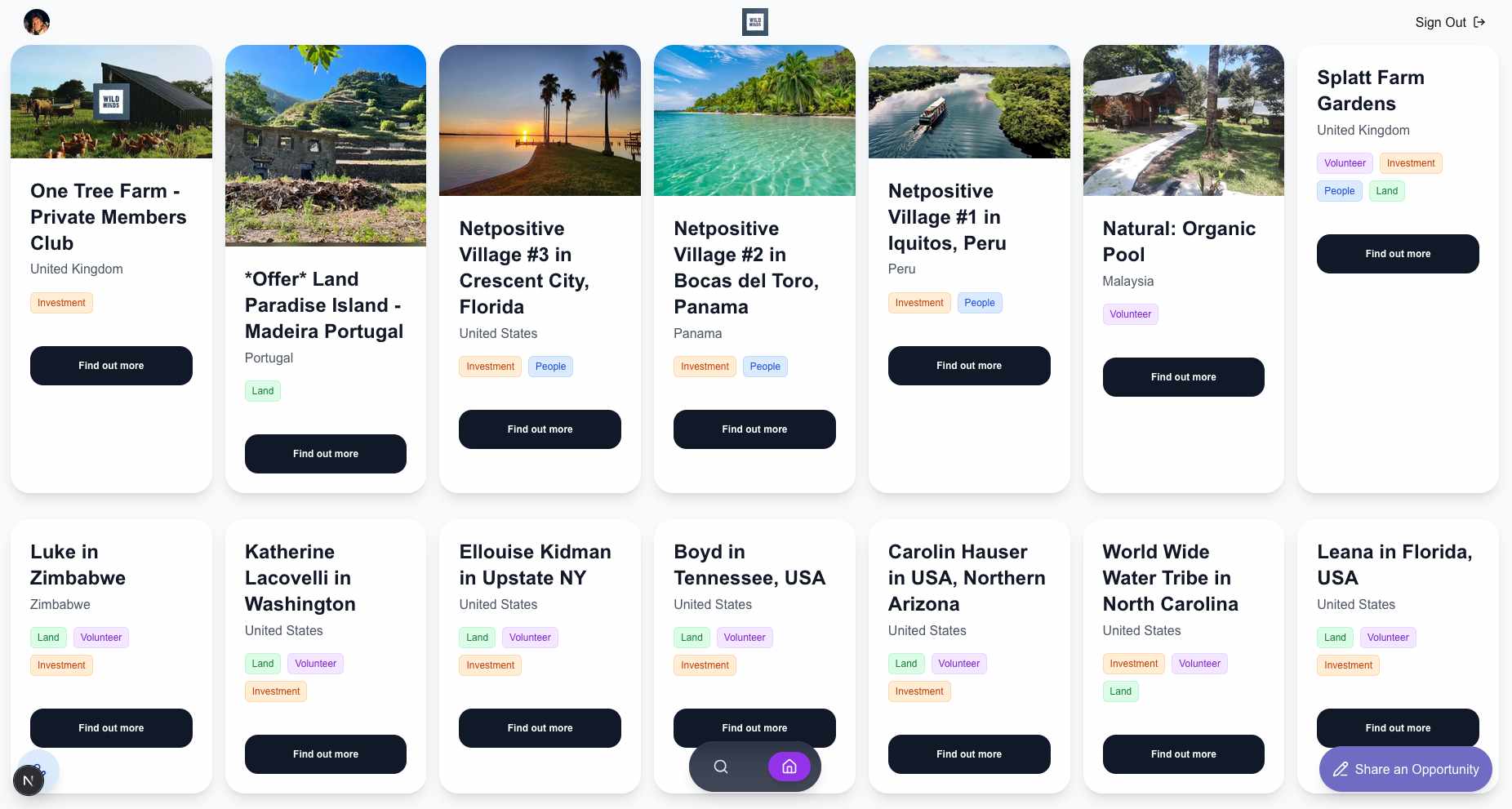
PS. We're releasing the new Wild Minds Network Database this weekend for people to find other like-minded people near them and look for opportunities to get involved in projects or buy some land. This is your chance to get in early and lock in a lower membership price as I continue to improve it.
Here's a sneak peek:
Click here to join 2150+ other members.